
After A School Shooting, I Watched Mothers Turn On Each Other. Imagine If We Turned On The System Instead.
Originally published in HuffPost on October 20, 2026.
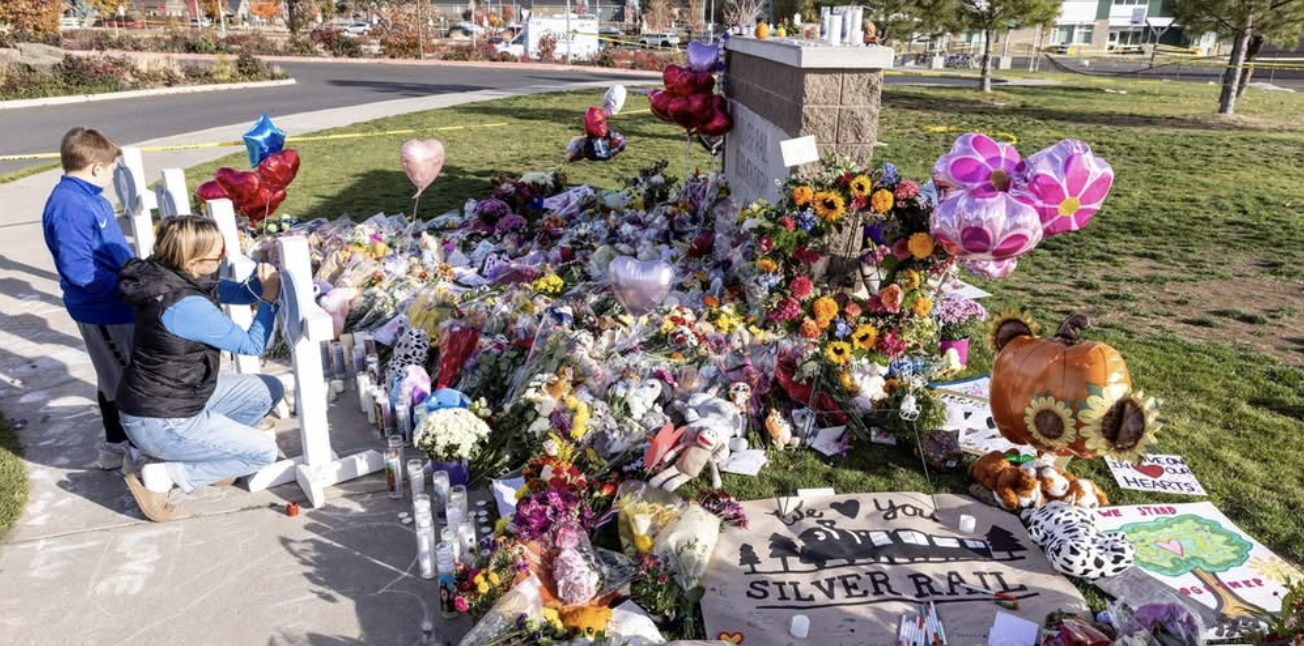
On Oct. 15, three children and a teacher were killed in a shooting at Silver Rail Elementary School in Bend, Oregon, the community I call home. Two others were injured. Families were shattered. Parents were left grappling with the unimaginable, and an entire community was plunged into grief.
In the hours that followed, I witnessed extraordinary acts of compassion.
Neighbors reached out to neighbors. People organized support for grieving families, offered resources, shared information and looked for ways to help. Thousands gathered for a vigil. In the face of unimaginable violence, our community demonstrated its capacity for love, generosity, and solidarity.
But I witnessed something else, too.
I’m the mother of an 11-year-old boy. On the day of the shooting, he was home sick from school. I was profoundly grateful that he was home, horrified by what had happened, and heartbroken for the families whose children would never come home again. And although my son was safe that day, I couldn’t shake the fear of what could happen the next time I sent him to school.
For years, I’ve belonged to a local Facebook group for mothers from all walks of life. It’s ordinarily a remarkably supportive community, where women encourage one another, share resources, and offer help without judgment. Cruelty isn’t tolerated.
In the aftermath of the shooting, I turned to that group looking for support. Instead, I found myself on the receiving end of another mother’s anger. She later apologized, an acknowledgment I appreciated. But I also witnessed mothers shaming one another in another local parenting group, dismissing fears and questioning whose suffering was legitimate.
Mothers were told their concerns were tone-deaf because, unlike other parents, their children were still alive. Some were told that if their children didn’t attend Silver Rail, they couldn’t possibly be as affected as families whose children did. Others were criticized for seeking alternative school arrangements for their own children, with suggestions that those opportunities should be reserved for Silver Rail families.
There were legitimate questions about how to prioritize limited resources for families directly affected by the shooting. But those conversations too often became something else: judgments about whose children mattered most, whose fear was justified, and who had earned the right to be distressed.
I watched mothers attempt to rank one another’s suffering.
And I kept wondering: Why are we doing this to each other?
The grief of parents who lost a child is unimaginable. Their loss deserves profound compassion and support. Families whose children experienced the shooting firsthand have needs that warrant particular attention.
But recognizing those truths does not require dismissing the distress of other children or silencing the concerns of their parents.
Trauma does not follow a neat hierarchy determined by school enrollment or proximity to violence. Children respond differently to frightening events, influenced by their experiences, developmental stages, relationships, and individual vulnerabilities. We cannot know the depth of another child’s distress simply by knowing which school they attend.
And we cannot measure a mother’s love or fear by comparing it with another mother’s loss.
Grief is not a competition. Neither is fear. Neither is love.
A mother can be profoundly grateful that her child is alive and still be frightened for that child’s safety. She can mourn the children who died while questioning how to support her own child through the aftermath. She can recognize another family’s unimaginable suffering without surrendering her responsibility to advocate for her own.
These truths can coexist.
Nearly two years ago, I wrote about how women are conditioned to suppress their anger rather than risk being labeled difficult or irrational. But anger isn’t inherently destructive. It tells us when something is unjust or something we love is threatened.
History shows what happens when women turn that anger into collective action. Suffragists fought for voting rights, labor activists demanded fair wages, feminists established domestic violence shelters, and survivors of sexual violence broke their silence through movements like #MeToo.
These movements were imperfect, especially for women of color and members of other marginalized communities, but they demonstrated something essential: when women organize around shared demands, private suffering can become public accountability.
So why, when our children are threatened by violence, are we directing so much of our anger at one another?
We are living in a violent nation, but we do not have to accept it.
Gun violence, sexual violence and domestic violence are different manifestations of a society in which violence has become disturbingly familiar, and those most vulnerable to it are too often expected to adapt rather than demand something better.
We teach children to survive active shooters, women to guard against assault and abuse, and survivors to navigate systems that may fail to protect them.
Some of these precautions are necessary. But why have we become so accustomed to placing the burden of preventing violence on the people who fear becoming its victims?
I am angry that three children and a teacher were killed in my community. That American children must practice hiding from people with weapons. That women continue to experience sexual and domestic violence at staggering rates.
And I am angry that, even when our shared vulnerability should bring us together, we sometimes turn on one another instead.
But I don’t want to turn that anger against other women.
I want us to use it.
Imagine what we could accomplish together.
Imagine if the energy spent criticizing another mother’s fear were directed toward demanding meaningful gun violence prevention, organizing community meetings, contacting lawmakers, supporting survivors, and advocating for trauma-informed services in schools.
We will not agree on everything. Unity does not require us to silence legitimate disagreements or ignore the unequal ways violence affects different communities. But disagreement does not have to become division.
We can recognize that some families need more immediate support without insisting that other families need none. We can prioritize those most severely affected without turning compassion into a scarce resource that must be rationed.
Anger alone will not create change. It must become sustained advocacy, political participation, and accountability. And that responsibility cannot fall on women alone.
Our children deserve more than our outrage.
I know that fear can make people lash out. I know that grief can narrow our capacity for compassion. And I recognize that the mothers whose comments troubled me were themselves responding to something horrific.
I do not want to shame them. I want to ask all of us, myself included, to consider where our anger is going.
Attacking another mother for worrying about her child does not bring back the children who died, comfort their families, or prevent the next act of violence.
But organizing together might.
What might happen if we recognized that the mother beside us, even the one with whom we disagree, is not our enemy?
I will not tell women to calm down.
Quite the opposite.
I want us to recognize the tremendous power of our anger.
To feel it. To honor it. To understand what it is telling us.
And then to put it to work.
Anger can divide us, or it can unite us. It can become cruelty, or it can become courage.
Our children deserve the world we might create if we stopped fighting one another and started fighting together for change.
With love and deep gratitude to walk alongside you,
💜 Natasha
Divorce Doula • Certified High-Conflict Divorce Coach • Certified Mediator
Educator • Survivor • Advocate • Author • Artist